
SandAPI: Dynamic API Endpoint Builder (No Code Required)
Dynamic API endpoint platform that lets developers create custom, working API endpoints in minutes without writing backend code, with user-specific namespaces.
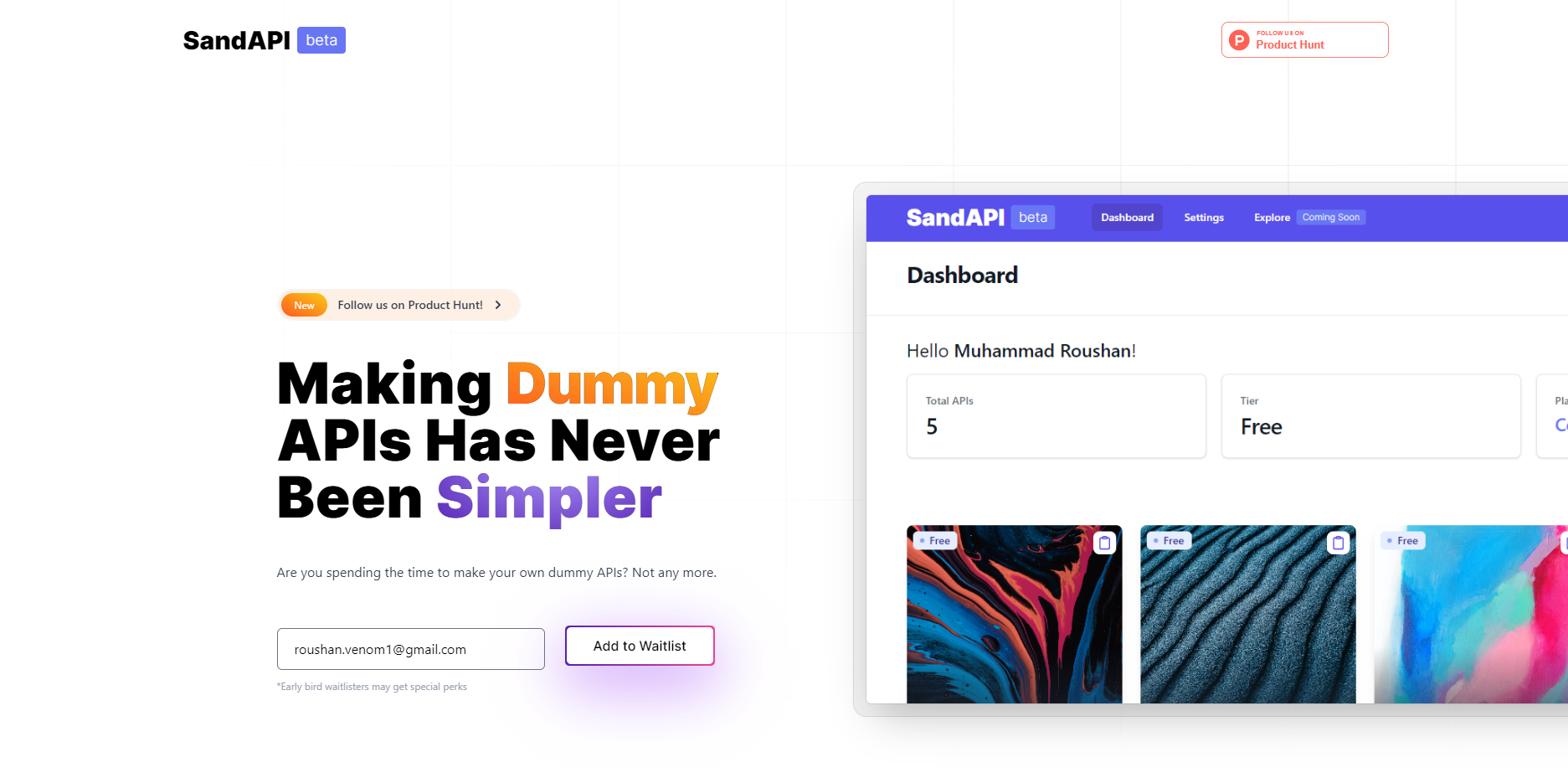
SandAPI: Dynamic API Endpoint Platform
Project Overview
SandAPI is a web-based platform that empowers developers to create custom, working API endpoints in minutes without writing any backend code. Think of it as a "sandbox" where developers can quickly prototype applications, test integrations, or build demos by generating realistic mock data through simple, user-friendly interfaces.
The Challenge
When developers are building applications, they often need to test how their frontend code interacts with backend services. Traditionally, this requires setting up servers, databases, and writing complex backend code—a process that can take hours or even days. We wanted to eliminate this friction by allowing developers to create fully functional API endpoints instantly, with each user having their own isolated, personalized namespace.
Our Solution: Dynamic User-Specific Endpoints
The Core Innovation
The heart of SandAPI lies in its ability to create unique, dynamic API endpoints for every user. When a user signs up, the system automatically generates a personalized namespace based on their unique identifier. This means each user gets their own "corner" of the API universe, completely isolated from other users.
For example, if a user's ID ends in "abc123", they receive their own API base URL: https://api.sandapi.com/user_abc123/. All endpoints they create are automatically prefixed with this unique identifier, ensuring complete data isolation and security.
How It Works
1. User Registration & Namespace Creation
When a new user signs up through our authentication system, we capture their unique user ID. The system then automatically generates a shortened, URL-friendly version of this ID (the last 6 characters) and creates their personal namespace. This happens instantly and transparently—the user doesn't need to do anything special.
2. Endpoint Creation Process
Users can create endpoints in two intuitive ways:
Option A: Bring Your Own JSON
- Users paste their own JSON data structure directly into a text editor
- The system validates the JSON in real-time, showing helpful error messages if the format is incorrect
- Once validated, the endpoint is ready to use immediately
Option B: Auto-Generate with Schema Builder
- Users build their data structure visually using a form-based interface
- They define field names (like "name", "email", "age") and choose data types
- For realistic data, users can select from a library of Faker.js options that generate random but realistic values (names, addresses, phone numbers, etc.)
- The system automatically generates sample data matching their schema
3. Dynamic Route Generation
When a user creates an endpoint, they provide:
- A friendly name (e.g., "User Profiles")
- A route path (e.g., "users")
- The HTTP method (GET, POST, or DELETE)
Behind the scenes, our system combines this information with the user's unique namespace to create a fully functional endpoint. For example:
- User namespace:
user_abc123 - Route path:
users - Final endpoint:
https://api.sandapi.com/user_abc123/users
4. Automatic Method Generation
For each endpoint created, the system automatically generates multiple HTTP methods:
- GET (list all): Returns all items in the collection
- GET (by ID): Returns a specific item when you provide its ID
- POST: Creates a new item in the collection
- DELETE: Removes an item by ID
This means users get a complete, RESTful API without having to configure each method individually.
5. Data Storage & Isolation
Each user's endpoints and data are stored separately in our database. When a request comes in, the system:
- Extracts the user namespace from the URL
- Validates that the user has permission to access that namespace
- Routes the request to the correct user's data
- Returns only that user's information
This multi-tenant architecture ensures complete data isolation—users can never accidentally access or modify another user's endpoints or data.
User Experience Features
Dashboard
- Users see all their endpoints in a clean, card-based layout
- Each card shows the endpoint name, method type, and a preview of the data structure
- Quick access to view, edit, or delete any endpoint
- Statistics showing total endpoints created and current subscription tier
Endpoint Management
- View Endpoint: Detailed view showing all available methods, example requests, and responses
- Edit Endpoint: Modify the data structure or schema without losing existing data
- Delete Endpoint: Safe deletion with confirmation dialogs to prevent accidents
Usage Analytics
- Visual charts showing how often each endpoint is being called
- Timeline view of API usage over the past few days
- Helps users understand which endpoints are most valuable
Code Examples
- Automatically generated code snippets in multiple programming languages
- Copy-paste ready examples for making requests to the endpoints
- Shows both request code (how to call the API) and response examples (what data you'll get back)
Schema Validation
- Optional "strict schema" mode that ensures data posted to endpoints matches the expected structure
- Prevents invalid data from being stored
- Provides clear error messages when validation fails
Technical Architecture Highlights
Frontend (User Interface)
- Built with React, providing a smooth, responsive user experience
- Real-time validation and feedback as users create endpoints
- Beautiful, modern UI using Tailwind CSS
- Client-side routing for seamless navigation
Backend Integration
- RESTful API that handles all endpoint creation, storage, and retrieval
- Secure authentication using Clerk
- Efficient database queries that scale with user growth
- Automatic generation of dynamic routes based on user IDs
Data Generation
- Integration with Faker.js library for generating realistic test data
- Support for various data types: strings, numbers, booleans, dates, objects, and arrays
- Customizable data generation rules per field
Security & Privacy
- Each user's data is completely isolated through unique namespaces
- Authentication required for all endpoint management operations
- Users can only access and modify their own endpoints
- Secure API endpoints that validate user permissions on every request
Real-World Impact
This platform solves a real problem for developers:
- Faster Prototyping: Developers can test frontend code immediately without waiting for backend development
- Better Testing: QA teams can test applications with realistic data without depending on production systems
- Educational Use: Students and learners can experiment with APIs without complex setup
- Demo Preparation: Sales and marketing teams can create impressive demos with working APIs
Development Process
The project was built iteratively, starting with core functionality (endpoint creation) and gradually adding features based on user feedback:
- Initial MVP: Basic endpoint creation with manual JSON input
- Schema Builder: Added visual schema creation for non-technical users
- Analytics: Implemented usage tracking and visualization
- Enhanced UX: Improved error handling, validation, and user guidance
- Code Examples: Added automatic code generation for better developer experience
Key Metrics & Achievements
- Supports unlimited endpoints per user (with tier-based limits)
- Instant endpoint creation—from idea to working API in under 30 seconds
- Zero backend code required from users
- Complete RESTful API support (GET, POST, DELETE)
- Real-time data validation and error feedback
- Beautiful, intuitive interface that requires no technical documentation to use
Conclusion
SandAPI demonstrates how thoughtful architecture can make complex technical concepts accessible to everyone. By creating a system that automatically generates unique, isolated endpoints for each user, we've built a platform that feels magical to use—users simply describe what they want, and the system handles all the complexity behind the scenes. The dynamic namespace system ensures scalability, security, and a personalized experience for every user, while the dual creation methods (manual JSON and visual schema builder) make the platform accessible to both technical and non-technical users.
The project showcases expertise in full-stack development, user experience design, API architecture, and multi-tenant systems—all while solving a real problem that developers face daily.